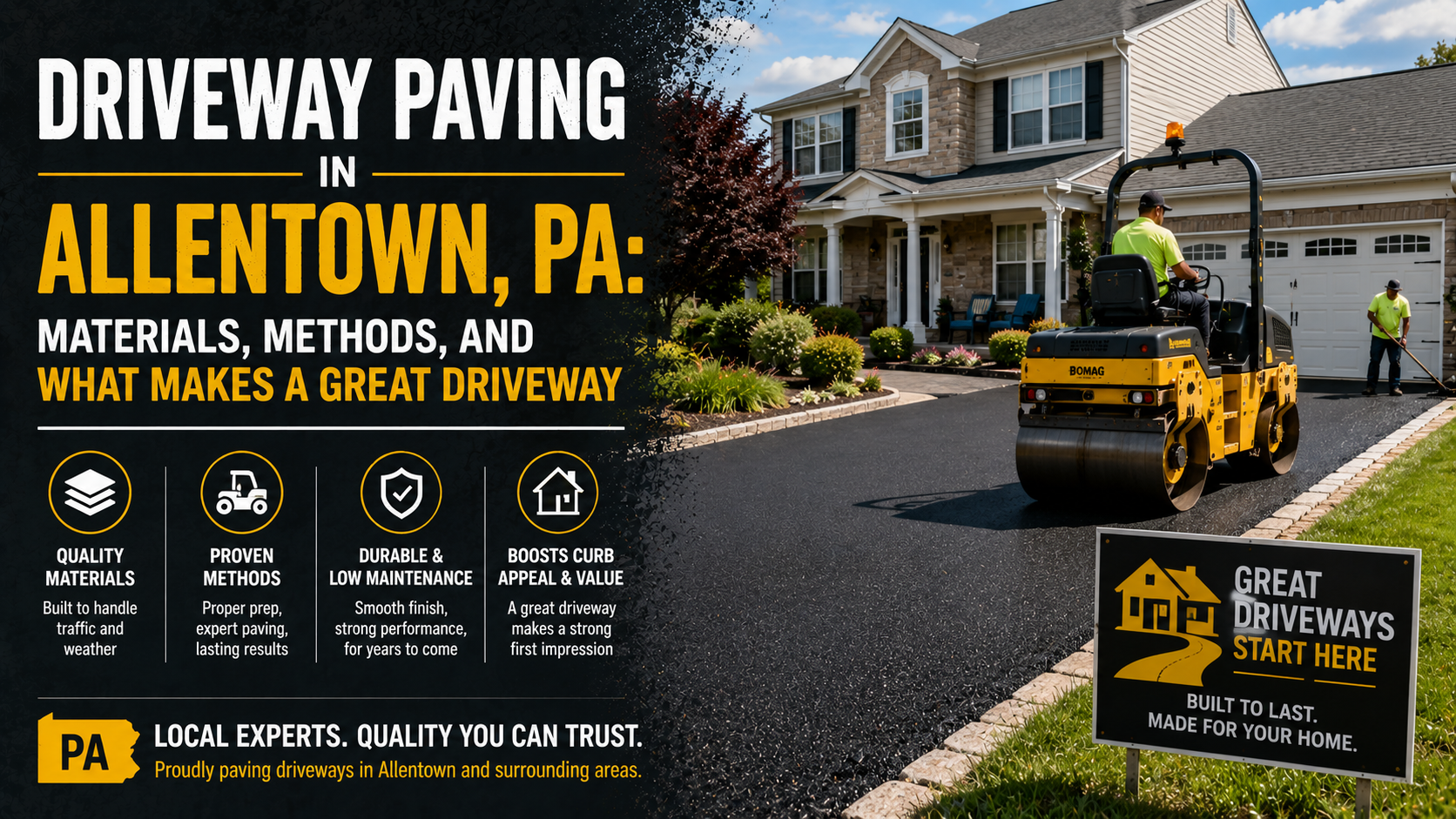
A driveway is among the most used and most visible features of any residential or commercial property. In Allentown, Pennsylvania, where the winters are cold and wet, the summers are hot and humid, and the ground shifts seasonally with frost and thaw, Driveway Paving Allentown is a subject that demands more than a casual approach. The right material, properly installed, can provide decades of reliable service. A poorly executed installation, regardless of the material used, can begin showing failures within just a few years.
This article explores the key considerations involved in driveway paving in Allentown, covering material options, the installation process, maintenance requirements, and the factors that distinguish a well-executed project from one that will require costly repairs down the line.
Common Driveway Paving Materials
Asphalt is by far the most popular driveway paving material in Allentown and throughout the Lehigh Valley. Its combination of durability, affordability, relatively quick installation, and compatibility with Pennsylvania’s climate makes it a natural choice for most homeowners. Asphalt’s flexibility allows it to accommodate ground movement caused by frost without cracking as readily as more rigid materials. Its dark surface helps melt snow and ice faster in winter, a practical advantage in Allentown’s climate.
Concrete is another widely used material that offers a different set of tradeoffs. Concrete driveways are generally more rigid and longer-lasting than asphalt when maintained well, but they are more susceptible to cracking from frost heave, more expensive to install, and require longer curing times before use. Concrete also shows stains more readily than asphalt and may require sealing to protect against deicing salts commonly used in Pennsylvania winters.
Gravel and crushed stone driveways represent a lower-cost alternative that works well in certain rural or semi-rural settings but requires more regular maintenance in the form of grading and replenishment. Interlocking pavers offer exceptional aesthetic flexibility and permeability but represent a higher upfront investment and are most commonly used for shorter or decorative driveways where appearance is a priority.
Factors That Affect Driveway Paving in Allentown’s Climate
The Lehigh Valley’s climate presents specific challenges for driveway paving. Frost penetration during cold winters exerts significant upward pressure on pavement as water in the soil freezes and expands. This process frost heave is a leading cause of driveway cracking and surface displacement. Properly installed driveways account for this by incorporating a deep aggregate base that provides drainage and resistance to frost-related movement.
Summer temperatures in Allentown can be quite high, which affects asphalt performance in a different way. In intense heat, asphalt can soften and become susceptible to tracking the displacement of surface material by heavy loads. Selecting the appropriate asphalt mix for local conditions and ensuring adequate compaction during installation minimizes this risk.
Drainage is another critical consideration. Allentown receives substantial rainfall throughout the year, and driveways that are not sloped and graded to direct water away from structures and off the paved surface can accumulate standing water, which accelerates sub-base erosion and accelerates freeze-thaw damage.
The Driveway Paving Process
A quality driveway paving project in Allentown follows a defined sequence. The first step is a thorough assessment of the site its dimensions, drainage characteristics, existing surface condition, and the specific needs of the property owner. For a new driveway installation, this includes establishing the proper layout and slope. For resurfacing or replacement, it involves evaluating whether the existing base is sound enough to reuse or must be excavated and rebuilt.
Excavation removes existing pavement or surface material and prepares the sub-grade to the required depth. Proper excavation depth is critical; too shallow a cut leaves insufficient room for a base layer that can handle Allentown’s frost depths. The sub-grade is compacted with mechanical equipment to create a stable foundation.
The aggregate base course is installed next. This layer of compacted crushed stone serves as the structural foundation of the driveway, providing load distribution, drainage, and resistance to sub-grade movement. The thickness and composition of the base are determined by local soil conditions and the intended traffic load.
Asphalt is laid over the prepared base using a paving machine, then immediately compacted with rollers while it is still hot enough to achieve the required density. Proper compaction is as important as any other step in the process; under-compacted asphalt is prone to premature cracking and surface failure. Edging and cleanup complete the installation, and the surface is typically ready for light use within a day or two.
Driveway Expansion, Widening, and Custom Work
Not every driveway paving project involves a simple replacement. Many Allentown property owners want to expand an existing driveway to accommodate additional vehicles, create a turnaround area, or improve access to a garage or side entrance. These projects require careful planning around existing landscaping, drainage patterns, property lines, and utility locations.
Custom work curved driveways, driveways with decorative borders or banding, or driveways integrated with other hardscape elements demands a higher level of design coordination and installation skill. A contractor experienced in both standard and custom residential paving can help property owners understand what is achievable within their budget and site constraints.
When to Repair vs. Replace a Driveway
Allentown homeowners with aging driveways frequently ask whether repair or full replacement is the right choice. The answer depends on the extent and type of damage. Surface cracking that has not penetrated through to the base, minor surface oxidation and weathering, or isolated areas of rough texture may be addressed effectively through crack filling, patching, and sealcoating a much less expensive option than full replacement.
More extensive damage alligator cracking (the interconnected cracking pattern that resembles an alligator’s back), large depressions, potholes, or areas where the pavement has settled or shifted typically indicates sub-base failure that cannot be corrected by surface treatments alone. In these cases, full removal and reinstallation is the only reliable solution.
Sealcoating: Protecting the Investment
Sealcoating is the most straightforward way to extend the life of an asphalt driveway in Allentown. Applied as a liquid coating to the cleaned surface, sealcoat bonds to the asphalt and creates a protective barrier against UV radiation, water, fuel and oil spills, and the general oxidation that causes asphalt to become brittle over time. Most paving professionals recommend applying the first sealcoat six months to a year after installation and then reapplying every three to five years thereafter.
A properly executed sealcoating job also restores the uniform dark appearance of an older driveway, improving curb appeal and making it easier to spot and address cracks before they worsen.
Conclusion
Driveway paving in Allentown is a multi-step process that requires attention to materials, climate conditions, base preparation, and ongoing maintenance. Whether the project involves a brand-new installation, the resurfacing of an aging driveway, or a custom expansion to accommodate changing needs, the principles of quality workmanship remain consistent: proper site assessment, adequate base depth and compaction, quality asphalt mix, and careful finishing. For Allentown homeowners, a well-paved driveway is not just a functional asset it is a visible expression of care for one of their most significant investments.